The Tambourine Doesn't Care: Late-Night Notes From a Karaoke Box
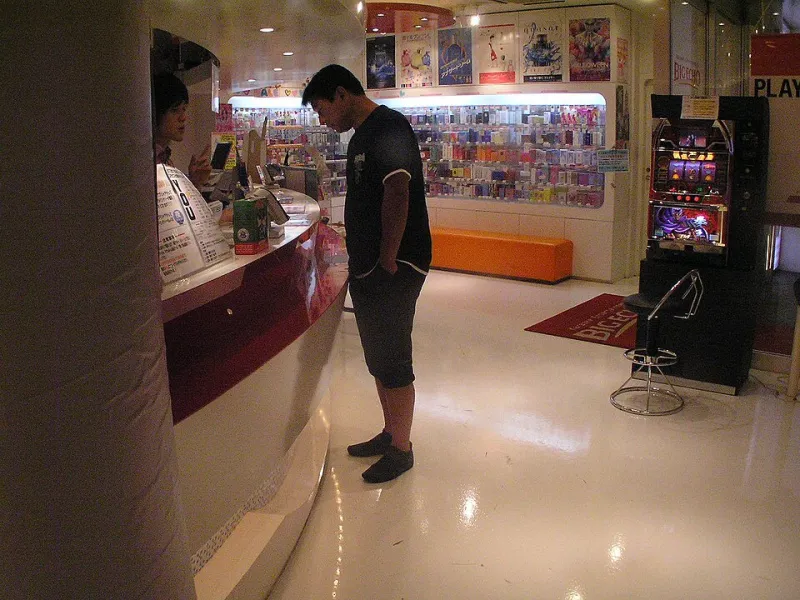
Photo: 松岡明芳, CC BY-SA 3.0, via Wikimedia Commons
The first thing you notice at 3 a.m. in a Japanese karaoke box is how quiet the hallway is. Doors lined up, each one padded, each one with a small window, each one leaking a muffled drum machine and one determined voice. It's the most attentive building I've ever been in, and almost nobody thinks of it that way.
The Room Is the Instrument
Karaoke in the US is a stage, or it's a screen in a bar with a stranger slurring through a Bon Jovi song while everyone looks at their phones. Japanese karaoke is a room the size of a large closet, rented by the half hour, occupied by six people who cannot escape one another. That's the entire difference and it changes everything.
I went three nights in a row last month, which is either a research method or a warning sign. The third night we got a room at 2:40 in the morning, sat down on the vinyl bench, and someone immediately started tapping the tambourine that lives permanently on the table. It was off the beat. It was also, in a way I'm still thinking about, the point.
Reception, Then the Long Walk
Every karaoke night starts the same way. You come in from the street and the reception counter is bright and cheerful in a way that feels aggressive at 1 a.m. There's a clipboard. There may be a laminated price sheet with a midnight pack written on it in red. The staff member asks how many people, how long, and hands you a room number and a drink menu, and then you walk down that long carpeted hallway and open the door.
If you've booked the all-you-can-drink option, the drinks come by phone. There's a handset on the wall. You pick it up, say a room number, and order a highball or an iced tea, and about six minutes later somebody knocks and delivers it. It's a hotel that only serves people who are about to embarrass themselves. I love it more than I can justify.
The Remote Is Part of the Ritual
Before anyone sings, someone has to find the song, and this is where the ceremony begins. There's a tablet these days, sure — the 2026 rooms are all touchscreens and song recommendations and a little avatar that grades your pitch — but somewhere on that table there is still a heavy plastic remote with buttons worn smooth by a decade of thumbs, and somebody always picks it up first.
The remote is the real instrument in the room. Whoever holds it has the set list. They have the power to slot in a duet, to queue a song that says something about the person they're sitting next to, and to skip in the middle of a chorus, which is a form of violence everyone politely ignores. Handing the remote over is the small act of trust that starts the night.
Somebody Always Sings the Ballad
There's a shape to these nights, and it's not the one I expected when I moved here. Nobody starts with the showstopper. You start with something easy, something in your range, something slightly apologetic, because everyone is still deciding what the room is going to be. Then around song four, the ballad happens.
It's a Japanese power ballad, usually — a slow, patient thing, the kind with an eight-second held note and a key change near the end, the kind that Japanese crowds know all the words to. Somebody sings it with their eyes half closed. Somebody else sings the harmony without being asked. And the room goes quiet in a way that a room full of drunk people at three in the morning has no business going quiet.
That's the moment I keep coming back for. Not the goofy group number, not the triumphant closer. The quiet one.
What 'Listening' Actually Means
Here's my argument, and I'll keep it short: karaoke isn't a performance business, it's an attention business. In a box, you cannot leave. There's nothing to look at except each other and the lyrics. So for four minutes, six people are entirely focused on one person's choice, one person's voice, one person's slightly shaky interpretation of a song they loved at seventeen. Nobody looks at their phone. Nobody is scrolling. There's no next table to impress.
Compare that to almost any other night out you can have. I can't think of another room in Japan, or anywhere else I've been, where the social contract is you will be looked at, and you will look back, and it's fine.
A Short Field Guide for First-Timers
- Open with the easy one. Pick a song you could sing into a hairbrush. Don't start with the high one.
- Queue a duet early. It pulls somebody in and it covers for you if you're nervous.
- Learn one chorus, not the whole song. Nobody in the room is scoring accuracy, and the screens are merciful.
- Order the weird drink. It's part of the ritual. It arrives at the wrong moment and that's the point.
- Take the tambourine once. Off the beat is permitted.
- End on a group song. Leave the quiet one for song four, not song last.
Last Order, Last Song
The wristband starts beeping and the phone on the wall rings with a friendly warning that your time is nearly up, and everybody picks one more song, and everybody says after this one and then doesn't leave. You step out into the 3 a.m. air with a sore throat and a room-temperature highball and a new small fondness for somebody who was terrible in a way you'll remember.
The tambourine is back on the table where it always was. It doesn't care how you sang. It never did. That's what makes it the best listening room in the country.