The Paperwork Inside the Plastic Ball: Field Notes on Gachapon's 300-Yen Design Miracle
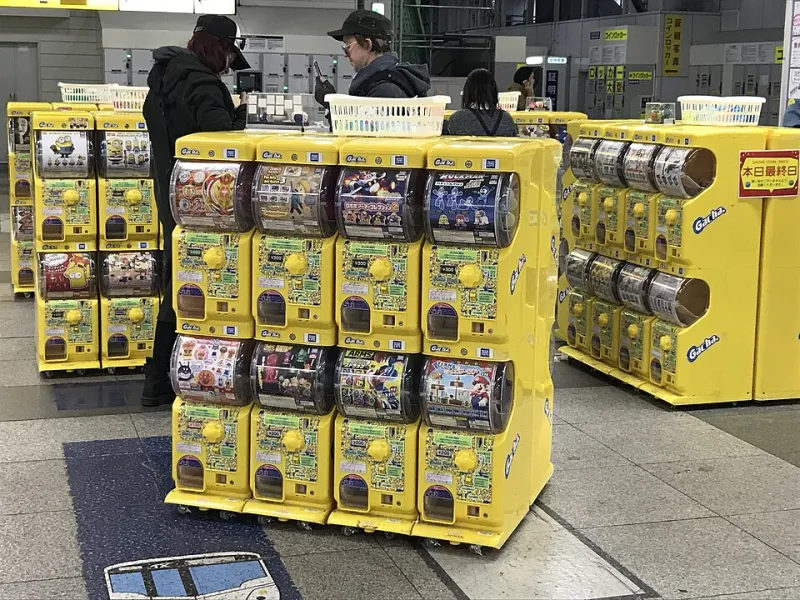
Photo: Ominae, CC BY-SA 4.0, via Wikimedia Commons
There is a specific sound a gachapon machine makes when the crank hits the end of its turn — a plastic crunch, then the hollow knock of a capsule dropping into the chute. I have chased that sound across three trips and roughly a dozen train stations. In Japan the machines are everywhere: a bank of them outside a Don Quijote, an entire floor of them at a Loft, a lone red-and-white unit tucked beside a supermarket entrance in a town with one traffic light. You feed in coins, you turn the handle, and out comes a ball the size of a golf ball with something absurd inside.
But here is my confession, and it is the reason this post exists: after about the fifteenth capsule, I started noticing that the thing I was most excited to open was not the toy. It was the paper.
The ball is not the container. The ball is the display case.
In the US, capsule machines turn up in grocery-store lobbies and mall corridors, and the format is familiar enough: a quarter, a bouncy ball, a temporary tattoo, a licensed figure that looks nothing like the sticker on the front. The wrapper is usually the point — a flat card you see before you buy, then throw away.
Japan runs the machine in the other direction. Two hundred to five hundred yen, and the capsule itself arrives sealed with a printed paper band wrapped around the middle, plus a folded instruction sheet tucked inside alongside the parts. The band is not a label. It is a small poster: the lineup of every possible figure, the series name, the maker's logo, a joke, sometimes a tiny map of the collection. Some brands print a mini comic. Some print a serial number that corresponds to nothing at all and exists purely so you feel like you got the one you got.
The capsule, meanwhile, comes in colors that are chosen, not randomized — pastel pink for a kitchen-miniature series, translucent blue for anything aquatic, matte white when the maker wants the object to look like it came from a pharmacy. Collectors in Japan trade capsules. I have met people who keep a shoebox of empty shells sorted by hue. I used to think that was deranged. I now own a shoebox.
Forty square millimeters of pure anxiety
The instruction sheet is where the design goes feral. We are talking about a piece of paper roughly the size of a postage stamp, folded down to four or eight panels, printed on both sides in two colors, that has to explain how to assemble something with six parts and no logical order.
And it does. Beautifully. There are numbered diagrams with arrows that loop back on themselves. There are callouts pointing at a peg with the word 「ここ」 ("here") and an arrow so specific it feels like the designer personally mistrusted you. There is almost always a tiny illustration of a hand holding the piece at the exact angle required, drawn with more care than most American instruction manuals give to furniture.
My favorite recurring detail is the disclaimer block, printed at a size that requires good lighting and patience: 「※画像と商品は異なります」 — the photo and the actual product may differ. On a three-hundred-yen toy. The maker has anticipated that you will scrutinize the paint job on a two-centimeter rice cooker and wish to preempt your complaint. That is not corporate caution. That is pride wearing a disguise.
The warning pictograms deserve a wall in a design museum
Nobody talks about the icons, and the icons are the best part. The age badge in a red circle. The little pictogram of a baby's face with a diagonal slash, which every Japanese package deploys to say "not for children under three." The choking-hazard drawing of a small part near a stylized throat. The ST mark, the safety certification stamp that appears on toys and looks like a tiny corporate seal from the Edo period.
Because the sheet is so small, the icons have to be legible at a glance, which means they have been boiled down to their absolute essentials — a whole regulatory vocabulary in black and white, roughly the size of a fingernail clipping. I have a sheet from a capsule series of miniature household appliances where the safety block takes up a third of the total printed area. The appliance itself is a refrigerator the size of a bean.
Three things worth hunting for
If you are in the US and want to see this craft up close, the machines are reachable — Japanese supermarkets, Kinokuniya, anime conventions, and the occasional mall operator who imports the real thing rather than the licensed junk. A few things to look for:
Balance-based toys. Kitan Club's cup-edge figures — the ones that perch on the rim of a drinking glass — come with a diagram that explains center of gravity, complete with a dotted line and a warning not to put them on hot drinks. The manual is essentially a physics lecture delivered in pictograms.
Multi-part miniatures. Ken Elephant and similar makers ship 1/12-scale objects with three or four pieces and a sheet that shows the assembly sequence in exploded view. Keep the sheet flat and it becomes a tiny technical drawing you can pin up.
Anything with a hand-drawn arrow. Some series are designed by one person, and you can tell: the arrows are slightly wobbly, the mascot in the corner is inked by hand, the joke in the margin is not a template. Those sheets are the closest thing the format has to a signed print.
The part nobody keeps, and why you should
Here is my gentle argument, and then I will let you get back to your day: keep the paper. Not in a drawer where it turns into confetti — flattened, in a notebook pocket, along with the capsule band. Three years from now the toy will be on a shelf and you will not remember which machine it came from. The sheet will tell you: the age badge dates it, the manufacturer's mark places it, the little diagram of a hand holding a peg at a forty-five-degree angle will remind you that somebody sat at a desk and cared about a three-hundred-yen piece of plastic more than anyone strictly needed to.
That is the souvenir. The ball is just how it travels.